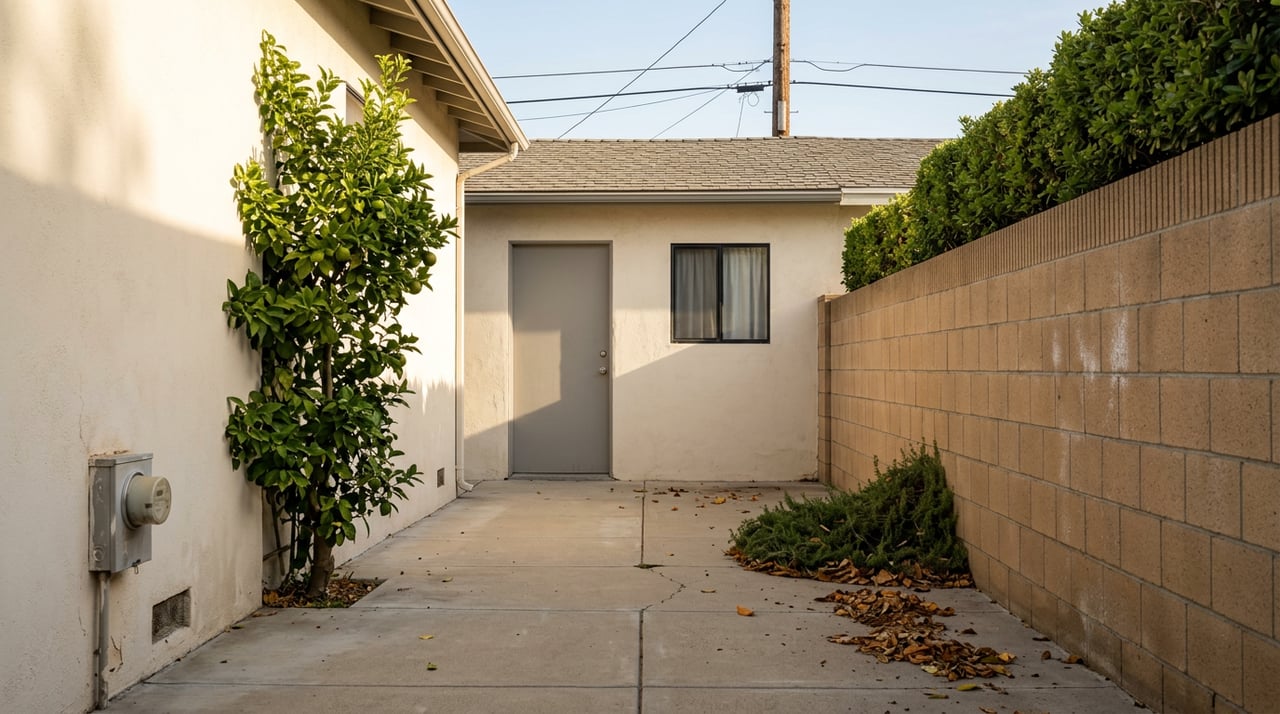
"We currently have two projects that are finished, construction complete, ready to go, sitting idle waiting for LADWP." That line comes from an ADU builder describing a routine holdup on Los Angeles projects earlier this year, and it lands differently once you know Lake Balboa has some of the best ADU lots in the San Fernando Valley. Large postwar parcels, many at 7,000 square feet or more, make the math look easy on paper. The state law everyone quotes promises a 60-day review. What the law doesn't cover is the part of the process where those two finished units are still sitting empty.
The 60-Day Number Everyone Quotes
Under AB 1332, cities must approve or deny a complete ADU application within 60 days, and if the city misses that window, the permit is automatically deemed approved. Paired with SB 543 and AB 1154, both effective January 1, 2026, the state has spent the last few years stripping out the discretionary hearings, owner-occupancy requirements, and parking mandates that used to slow projects down. AB 976 permanently removed the owner-occupancy requirement altogether, which matters if you're weighing Lake Balboa as an absentee rental play rather than a place you'll live yourself.
That 60-day clock is real. It's also only one department's clock.
Where the Clock Actually Stops
The Los Angeles Department of Building and Safety runs the ministerial review the state law governs. The Los Angeles Department of Water and Power runs something else entirely, and LADWP's own encroachment rule is unambiguous: any structure within 10 feet of one of its easements, or within 15 feet of a pole line, needs a separate encroachment clearance before the department signs off. That review doesn't answer to the 60-day standard, and one ADU builder working across Los Angeles reported earlier this year that the referral rate runs at roughly one in five to six applications, with water service processing alone averaging about 90 days before construction can even start.
On a Lake Balboa lot, where mature trees and older overhead lines are common along many blocks, that referral risk is higher than a buyer running the numbers off a state law headline would assume. A property that looks like a straightforward six-month build can turn into a ten-month or fourteen-month one, and the delay has nothing to do with your architect, your contractor, or your paperwork. It has to do with where the pole is.
Here's roughly how the stages stack up for a typical Lake Balboa detached build:
| Stage | Typical Time | What Extends It |
|---|---|---|
| Architectural drawings | 4 to 8 weeks | Custom design instead of a pre-approved standard plan |
| LADBS plan check | 4 to 8 weeks | Correction cycles that reset the review |
| LADWP encroachment review, if triggered | 90 days or more | Any structure within 15 feet of an overhead line or 10 feet of an easement |
| Construction | 3 to 7 months | Utility hookups, foundation work, finish level |
Every one of those first three stages can run in parallel if you start the utility check early. Most homeowners don't, because nobody tells them to check pole location before they finalize a floor plan.
The Open-Permit Problem Sitting in Older Lake Balboa Houses
There's a second bottleneck that has nothing to do with utilities and everything to do with Lake Balboa's housing stock. Much of the neighborhood was built in a single postwar wave, and as we've covered in our look at Lake Balboa home styles, a lot of what looks like a fully updated ranch is really an older structure with layered remodels on top. Garage conversions, room additions, and cosmetic updates done without permits are common enough that they show up regularly in LADBS records.
Here's the part that catches people off guard. An ADU application on a property with open, unresolved permits on the main house can stall before it ever reaches the LADWP queue, because LADBS wants that history closed out first. This is a separate issue from a nonconforming structure that predates current zoning, which the ADU ordinance generally leaves alone under LAMC 12.22.A.33(h)(4). The problem isn't an old setback violation. It's a permit that was pulled and never finaled, sitting open in the city's system for years.
If you're evaluating a Lake Balboa property specifically for ADU potential, pulling the LADBS permit history on the main house before you write an offer tells you more about your real timeline than any contractor's quote will.
What the Build Actually Returns
Assume you clear both bottlenecks. What does a Lake Balboa ADU actually pencil out to in 2026?
A detached unit on a typical lot runs somewhere between $180,000 and $320,000 depending on size, foundation conditions, and finish level, with garage conversions coming in lower, often $90,000 to $150,000, though you give up the garage storage that plenty of Lake Balboa buyers still want at resale. Rent on a well-finished 700 to 900 square foot unit is landing around $2,400 to $3,200 a month this year, which sounds like a strong number until you run the full return. A $250,000 build renting for $2,800 a month generates about $33,600 a year in gross rent. After the property tax increase on the new assessed improvement, insurance, maintenance, and a reasonable vacancy assumption, net income lands closer to $26,000, which works out to roughly 10 percent on the capital tied up in the unit. That's a solid return. It is not the kind of number that makes the decision for you.
The resale side tells a similar story. A well-built $250,000 ADU typically adds something in the range of $130,000 to $200,000 in resale value, not a dollar-for-dollar match to what you spent. The gap isn't a reason to skip the project. It is a reason to think carefully about finish level if you might sell within a few years, since the rental income is what closes that gap over time, not the sale price alone.
A few questions worth answering honestly before you commit:
- Are you planning to hold the property for five years or more, long enough for rental income to offset the spread between build cost and resale value.
- Can you absorb an unexpected $30,000 overrun without straining your finances.
- Does the lot genuinely support a good-sized unit without swallowing the main house's usable yard.
- Have you confirmed there's no overhead line or easement within the LADWP's 10 or 15 foot trigger distance.
- Have you pulled the main house's LADBS permit history to rule out an open permit that could stall the application before it starts.
If the answer to most of these is yes, the math tends to work. If you're building mainly because it's what everyone on the street seems to be doing, the numbers above are worth sitting with a little longer.
A Sequencing Move That Saves Months
The single most useful thing a Lake Balboa homeowner can do before hiring anyone is check pole and easement location relative to the planned ADU footprint, and submit any required LADWP review as soon as the general footprint is set, not after the architectural drawings are finished. Running that utility check in parallel with design and plan check, rather than after both, is the difference between a realistic six to seven month build and one that stretches into its second year.
FAQ
Does the state's 60-day rule apply to LADWP's review too? No. The 60-day ministerial standard under AB 1332 governs the local building department's decision on your application. LADWP's encroachment clearance is a separate utility review with its own timeline, and it commonly runs 90 days or longer when triggered.
Can I still build an ADU if my main house has an old, unpermitted garage conversion? It depends on whether that conversion was ever pulled as a permit and left open in city records, versus never permitted at all under current nonconforming-structure rules. An open, unresolved permit is the more common problem, and it's worth checking LADBS records before you design anything.
Does converting an existing garage instead of building detached avoid the LADWP wait? Only if the structure is already outside the 10 or 15 foot trigger distance from a line or easement. Location relative to the utility infrastructure, not the type of conversion, is what determines whether the review applies.
The lots that make Lake Balboa attractive for an ADU are the same lots where these questions actually matter. If you're weighing a purchase here with rental income or multigenerational housing in mind, or you already own in Lake Balboa and want a straight read on what your property can realistically support, Arthur Aslanian can walk through the permit history, the lot specifics, and what a complimentary staging consultation and market valuation would look like for your situation.
